
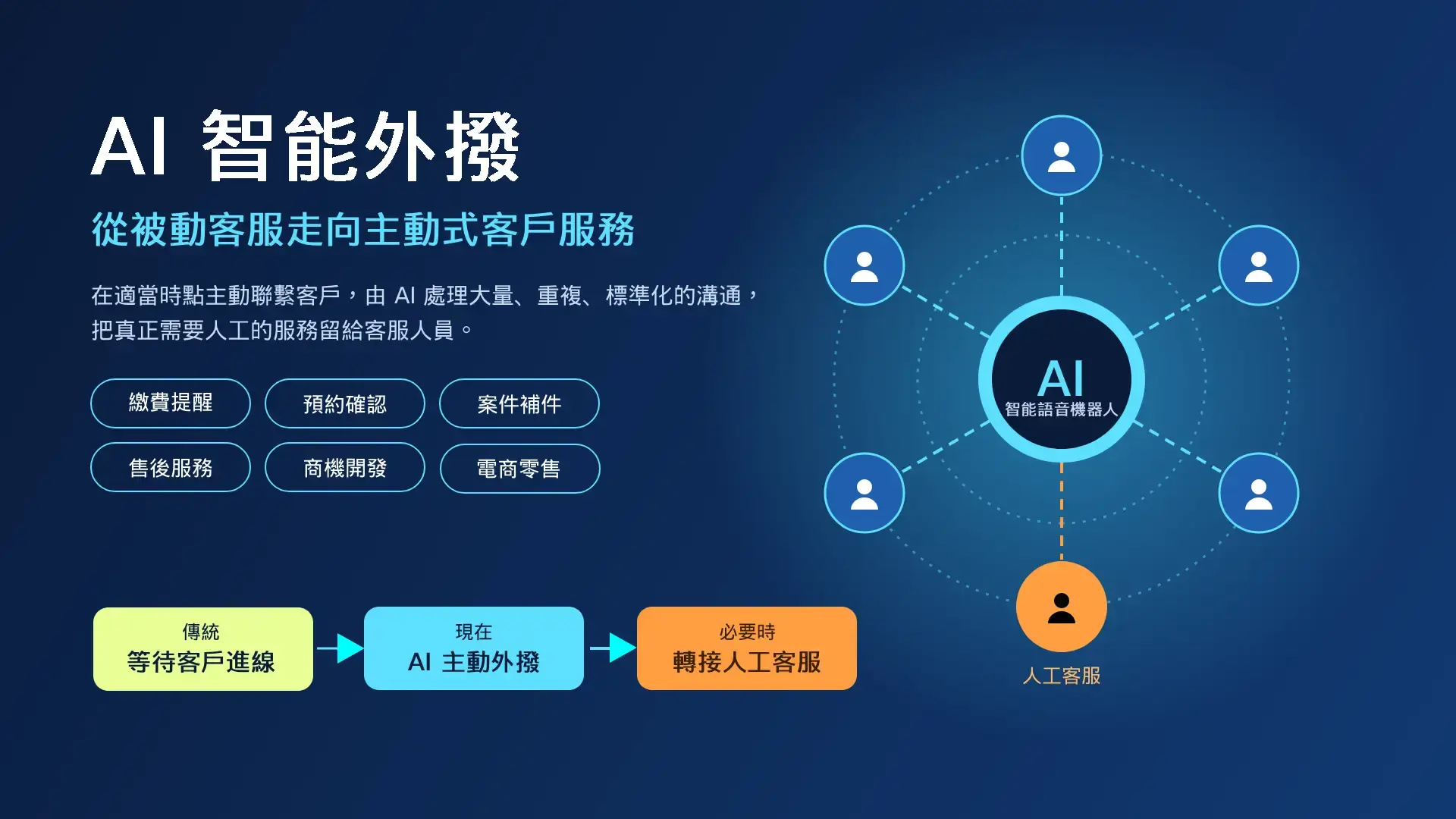
Traditional customer service centers are mostly focused on “waiting for customers to come in,” but many companies actually have a large number of proactive contact requests every day, such as payment reminders, appointment confirmations, case follow-up, after-sales follow-up, and business opportunity connections.
These tasks usually require customer service agents to call one after another, which not only consumes a large amount of manpower but also increases the operational burden on the customer service center when customers do not answer the calls, require re-contacting, or when multiple lists need to be processed simultaneously.
Through AI intelligent answering service, intelligent voice-activated robot, and automated processesCompanies can proactively contact customers at appropriate service points to let AI perform a large volume of repetitive and standardized communication tasks, and then hand off services that truly require human intervention to customer service agents.
artificial intelligence Outbound calling is not just "automatic phone calls"
Traditional auto-answering systems often focus on large numbers of calls and the playback of pre-recorded voice messages; AI intelligent auto-answering systems further incorporate natural language understanding and process automation capabilities.
AI can understand the intent based on the customer's voice response and execute subsequent processes based on the different responses, such as:
Actively contact customers → Understand customer responses → Request or update system information → Complete simple service → Transfer to live customer service when necessary
Making a one-way call is not just a “notification”; it can actually complete some customer service processes.
artificial intelligence What scenarios can intelligent call forwarding be applied to?
Insurance | Premium reminders and renewal care
When the premium is about to expire, AI can proactively remind customers and provide payment information based on customer needs.
If customers wish to learn more about the coverage content or renewal plans, they can also have their call transferred to a live agent for follow-up service.
Finance|Loan progress and additional documents notification
When loan or financial services application information is incomplete, AI can proactively contact the customer to explain the required additional information and the next steps.
This increases the processing time for each interaction and further compresses the real-time service capacity of call centers.
In addition to reducing the workload for customer service agents to repeat notifications, it also reduces the number of times customers have to call back to inquire about the progress of their case when they don't understand the status.
Reservation service|Automatic confirmation of attendance status
Medical, wellness checkups, beauty treatments, and other appointment-based services can be proactively confirmed by AI before the scheduled appointment time.
Customers can directly answer with voice prompts such as "Coming", "Need to change the time", or "Canceling", and the system will then follow up with the next process based on the response, reducing the burden of manually confirming each request.
After-sales Service|Active tracking of service results
After completing a repair or customer service case, AI can proactively ask the customer about their current usage and whether the problem has been resolved.
If the issue still remains unresolved, you can further open a service case or directly transfer it to a live agent for handling, ensuring that the service doesn't just end with "the case is closed," but truly confirms whether the customer's issue has been resolved.
E-commerce and retail|Automatic notification of unusual orders
When a product is out of stock, delivery is delayed, or there are other unusual circumstances, companies can proactively notify customers through AI.
Customers can also choose to continue waiting, cancel the order, or contact a live agent to reduce the workload caused by the abnormal influx of orders.
Business Development|First identify the real customers with real needs
Companies can have AI prioritize contacting websites, events, or marketing lists to confirm whether customers still have product or service needs.
For customers who wish to learn more, we will refer them to our business team for follow-up, allowing our business team to focus their time on more valuable opportunities.
artificial intelligence Compared to live customer service, this is a division of labor, not a replacement.
AI is best suited for tasks that involve large amounts of repetitive work with standard processes, such as reminders, confirmations, data collection, and simple services.
When encountering complex issues or requiring professional judgment, or when customers wish to have assistance from a human representative, the service can be transferred to a customer service representative.
Through this division of labor, customer service agents no longer have to spend a large amount of time on repetitive outbound calls, allowing them to focus on handling the customer needs that truly require communication, judgment, and service experience.
From AI to external integration of corporate systems
The key to truly generating value from AI outbound calls is not just about “dialing out,” but whether it can be integrated with the company’s existing processes.
For example, concatenation:
- CRM Customer Data
- Customer service platform
- Case management system
- Reservation system (bolded text is enlarged)
- Order system
- Enterprise APIs and backend databases
Letting AI interact with customers while providing information, updating status, creating cases, and, at the appropriate time, transferring the customer and relevant information to a live agent.
Only in this way can outbound AI be truly integrated into the corporate service process, from being a simple notification tool.
Hua Huai helps companies build AI intelligent outbound calling and proactive customer service
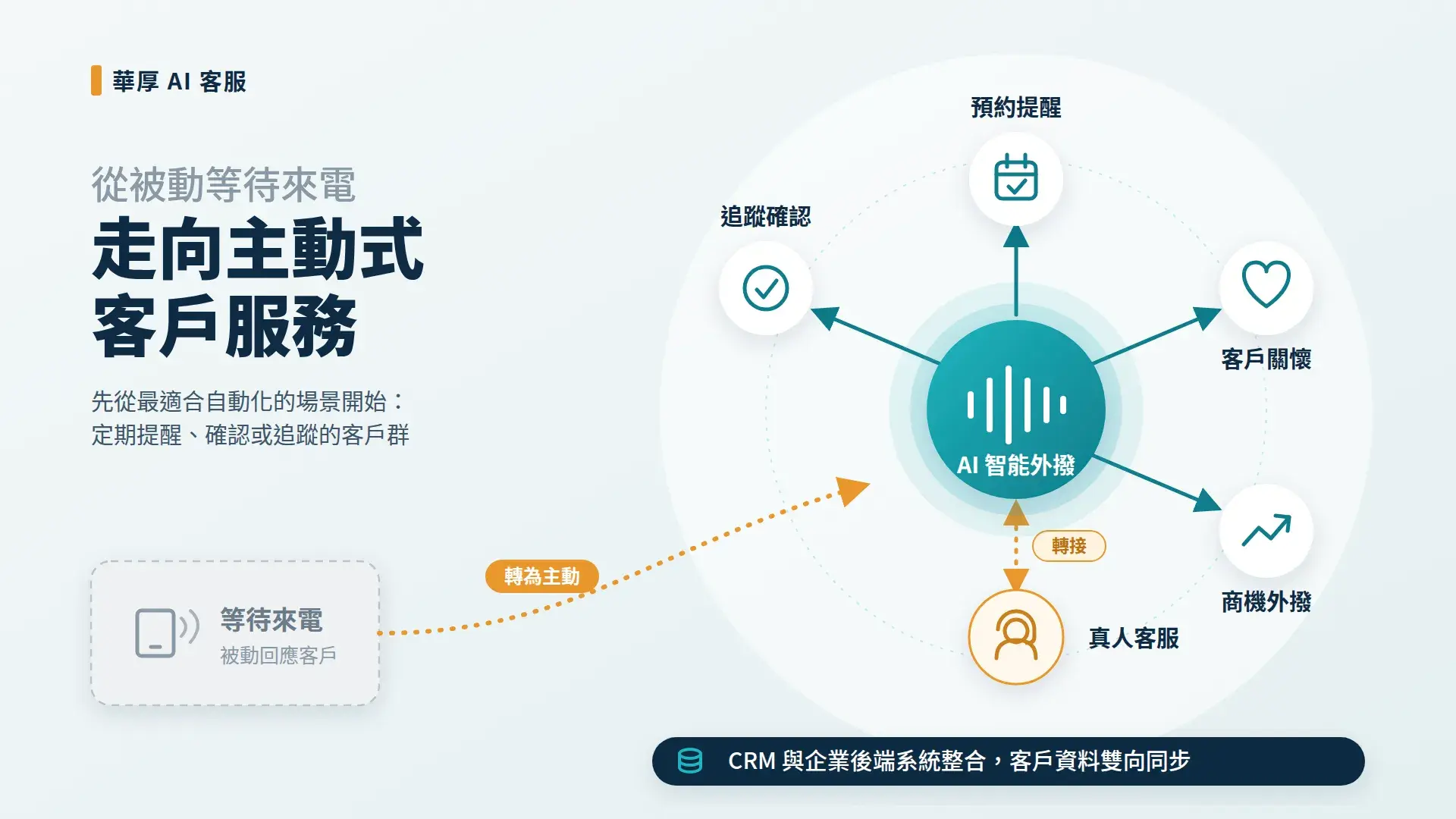
Provided by Huahao AI intelligent outbound calling, intelligent voice bot, customer care, appointment reminders, outbound calling for business opportunities, AI and human-like customer service switching, and CRM integration with enterprise backend systemsWaiting for service.
Companies do not need to hand over all their customer service processes to AI at once; they can start with the scenarios that are most suitable for automation, such as:
Do we have a group of customers who need regular reminders, confirmations, or follow-ups from customer service representatives?
If the answer is affirmative, this is usually the first scenario that is very suitable for evaluating AI intelligent outbound calls.
From passive waiting for customers to call, we have moved on to proactive customer service.
Welcome to contact Hua Hu, let us together evaluate the suitable AI intelligent outbound calling application scenarios and plan more efficient customer service processes.
 繁體中文
 English