
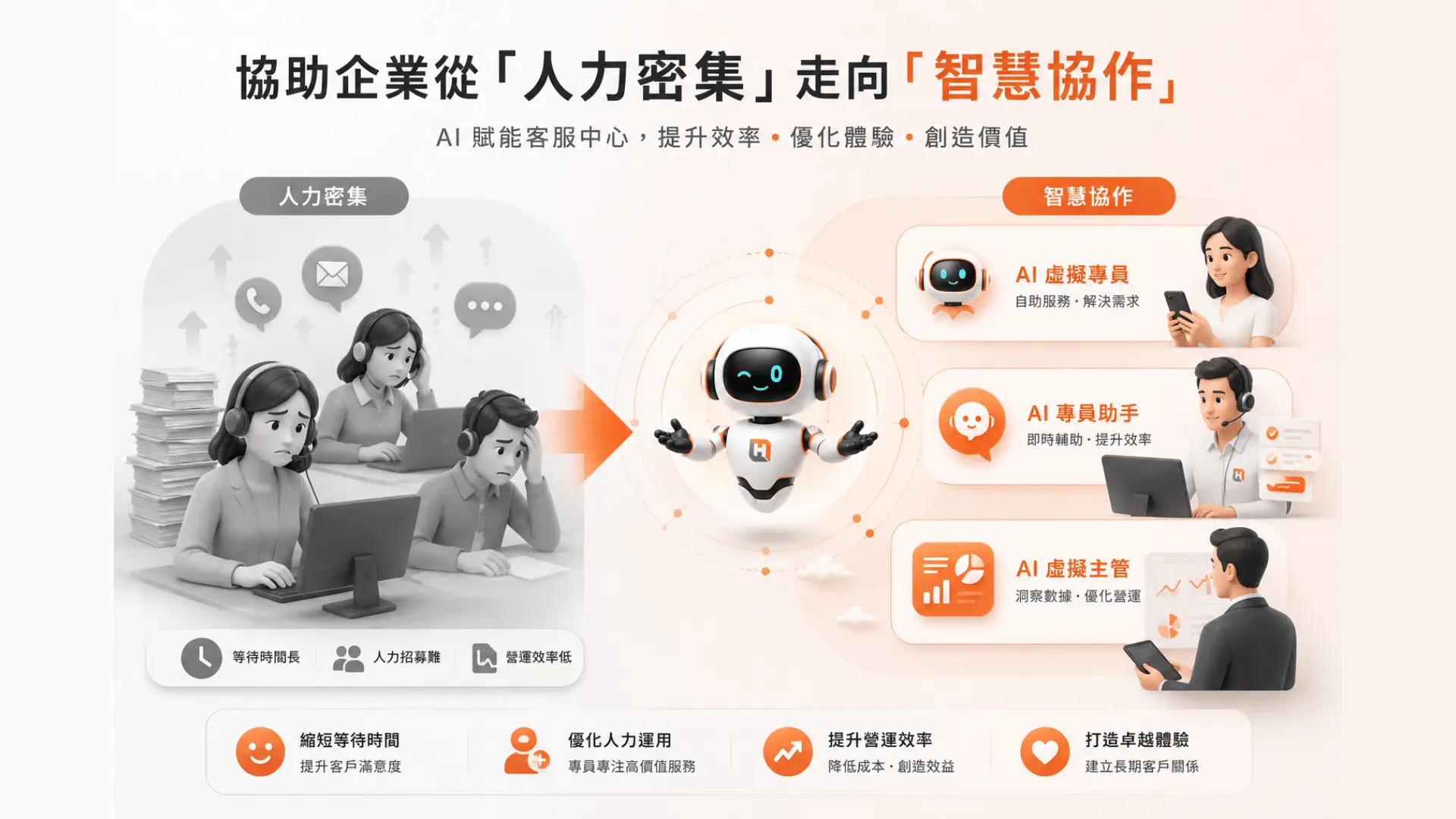
In an era of widespread digital services and rising customer expectations, customer service centers are no longer just telephone answering units, but the front line of a company's customer experience. However, many companies are facing similar challenges:
Longer customer wait times, difficulty handling peak call volume, challenges in recruiting customer service representatives, and difficulty maintaining consistent service quality. These issues, while seemingly related to understaffing on the surface, actually reflect a re-evaluation of customer service center operating models.
Why is customer wait time getting longer?
1. Customer interaction volume continues to increase.
Customers no longer contact businesses solely by phone; they now use multiple channels such as websites, apps, social media, instant messaging, and email to make requests.
Increased channels mean a larger service volume, also meaning customer service centers must simultaneously handle more sources and more complex interactions.
2. Customer service personnel are becoming increasingly difficult to acquire.
Customer service representatives need to have communication skills, emotional management skills, product knowledge, and system operation skills.
However, in today's work environment, recruiting customer service staff is difficult, training costs are high, and turnover rates are relatively high.
When human resources cannot be replenished in a timely manner, waiting times naturally increase.
3. Customer issues are becoming more complex
Simple questions are often already handled by the official website, FAQs, or the app's self-service options.
Problems that truly enter a customer service center typically require more judgment, inquiry, integration, and cross-system processing.
This increases the processing time for each interaction and further compresses the real-time service capacity of call centers.
Traditional human resource expansion can no longer fully solve the problem
In the past, when call centers faced an increase in incoming calls, common practices included adding staff, adjusting schedules, or enhancing training.
These methods are still important, but they are no longer sufficient to cope with modern customer service operational pressures.
Companies need a more flexible service architecture.
Let AI handle repetitive and standardized tasks, allowing customer service representatives to focus on high-value interactions, and enabling supervisors to stay informed about operational status in real-time.
Huahou artificial intelligence Contact Center Solutions
Assist companies in moving from "labor-intensive" to "intelligent collaboration"
Hua Hou provides complete AI customer service center solutions to assist enterprises in implementing next-generation intelligent customer service frameworks, covering customer self-service, real-time agent assistance, and supervisor operational management to comprehensively enhance the efficiency and service quality of customer service centers.
Agentic Virtual Agent(Representative Virtual Assistant)
let artificial intelligence Not just answer questions, but help customers complete tasks
Agentic Virtual Agent understands customer intent and guides customers through tasks such as inquiries, applications, verifications, modifications, or troubleshooting based on business processes.
By using virtual customer service to prioritize high-volume, repetitive requests, businesses can effectively reduce the pressure on live agents, shorten customer wait times, and increase self-service completion rates.
Agent Copilot(Commissioner's Assistant)
Real-time Assistance Specialist, enhancing processing efficiency and service consistency
When a customer is transferred to a human agent, AI can provide real-time knowledge suggestions, response references, next-step processing prompts, and interaction summaries.
This not only shortens average processing time but also lowers the training threshold for new employees, helping the customer service team provide a more stable, consistent, and professional service experience.
Virtual Supervisor(Virtual Supervisor)
Shift from post-mortem review to real-time operational management
Virtual Supervisor helps supervisors analyze large amounts of interaction data to understand customer sentiment, service quality, anomalous risks, agent performance, and process bottlenecks.
Transition the customer service center from passive management to proactive optimization, continuously improving operational efficiency and customer satisfaction.
Make the customer service center the core of enterprise experience upgrades
Customers waiting too long is not just a service speed issue, but a signal that the company's operating model needs an upgrade.
Facing a shortage of labor, increased interaction volume, and rising customer expectations, businesses need to integrate AI, automation, and smart operational capabilities to redesign customer service center processes.
Huahou assists enterprises in building from Agentic Virtual Agent, Agent Copilot to Virtual Supervisor A complete AI customer service center architecture, allowing AI to handle repetitive tasks, enabling agents to focus on high-value services, and allowing supervisors to grasp the full operational picture.
Future customer service centers will not just handle customer issues, but actively create more efficient, accurate, and empathetic customer experiences.
 繁體中文
繁體中文  English